Saturday, 20 August 2011

The Baltic Mill, Gateshead

Robert Breer  


   Float, 1972, resin, paint, wood, motor                                   
    
                                  
Rug,1968, two motors, golden sheet   Tableau, 1965, canvason structure, motor

 
                             Panorama 1, 2005                             Variations, 1970

                      Fuji, 1974, drawings from the film Fuji


If I am honest, I did not 'get' any of Robert Breer's work.  I often find it hard to appreciate contemporary art if I cannot identify with the making process, or see clearly the time put into a piece.  For example, 'Rug' instantly lost my attention for obvious reasons.  However, I did find his films a little more interesting.  The soothing French speaker on top of an array of Kandinsky style drawings was quite therapeutic and seeing the film frames helped me recognise the amount of work put into one film.


 Maurizio Anzeri

I am Red, 2010, synthetic hair, sewn threads    Twins, 2010, synthetic hair, sewn threads

Maurizio Anzeri was definitely my favourite installation. The small room featured 2 large sculptures, made of synthetic hair and stitch.  If anything, the scale of these pieces was impressive, each standing about 7ft tall with layers and layers of hair.  The braidings and weaving of the hair created appealing textures and allowed the hair to take sturdier form.  I think 'Twins' was especially enthralling, due to the nature of my own theme.

 
  Family, 2011, embroidery on print

                      Giorgio, 2010, Embroidery on print       2010, Embroidery on print  

The extensive amount of framed embroidered photographs was very exciting to me.  His geometric line work, with their precise stitch patterns and colour choices instantly grabbed my attention.  I was in awe of the way the stitched were taught, but did not interfere with the quality of the photographic print.

Mariah Robertson

     44, 2011, C-print on metallic paper

Again, scale played a large part in making this work successful.  The large reels of metallic paper printed with bold colours and forms made the work eye-catching, drawing the audience closer.  Up close, the smaller details were the more intriguing parts of the work. However, I must admit, this part of the exhibition did not get my juices flowing.

 
                             8, 2011, C-print on metallic paper    9, 2011, C-print on metallic paper


Overall, I felt indifferent to most of the work featured at The Baltic.  This is probably considered one of the most offending emotions when it comes to someone’s art, but I cannot help but feel like the work, with the exception of Maurizio Anzeri, was neither offending nor exciting to me.

Tuesday, 16 August 2011

Leeds Art Gallery

Francis Bacon

 
                      Head VI, 1949

I have been a fan of Francis Bacon's work for quite some time, and his Pope series is top of my list.  In the past, I have created work based on this group of paintings, so seeing one in the flesh was really astonishing.

Ergin Cavusoglu

   Poised in the Infinate Ocean, 2004, 3 screen video installation with sound

Video art often loses my attention very quickly.  However this 3 screen installation by Ergin Cavusoglu kept me for quite some time.  The grand house and light house were particularly inviting, and I could not stop staring at the extravagance of each building.  I also enjoyed the transformation between night and day.

Frederico Camara

   Untitled [Tropical World, Leeds], 2007, colour photograph

    Untitled [Stuttgart], 2008, colour photograph

Frederico Camara's photographs of empty zoo enclosures have a haunting air about them.  I find 'Untitled [Stuttgart]' particularly eerie due to its surgical style colourings and open spaces.  The viewer may ask why the rooms are empty, and how come there is little trace of their every being life?  On the other hand, 'Untitled [Tropical World, Leeds]' does carry a feeling of warmth.

 Brian Griffiths

   Return of Enos, 2000, carpet, cardboard and tape

I think the most appealing thing about this sculpture is its materials.  Brian Griffiths uses nothing but simple household objects to recreate the infamous Enos, the first ape to go to space.  The combination has created the perfect replica that is quite endearing.

John N. Rhodes

   Study of a Skull, Book and Scroll of Paper, oil on canvas

Although this painting was the smallest in the room, I was the one I spent the longest looking at.  The detail and precise tones combined with the delicate brush strokes made 'Study of a Skull, Book and Scroll of Paper' one of the most realistic looking paintings to grace my eyeballs.

John Byam Liston Shaw
 
  Such is Life, 1907, oil on canvas

My main reason for including this painting in this review is down to my bad observational skills.  It wasn't until I returned home and looked over my photographs that I noticed the policeman in the center of the painting.  His looming dark presence is counteracted by the calm and accepting expression.

Damien Hirst

 
  Away from the Flock, 1994
                                Mantra, 2008, butterflies, household gloss on canvas 

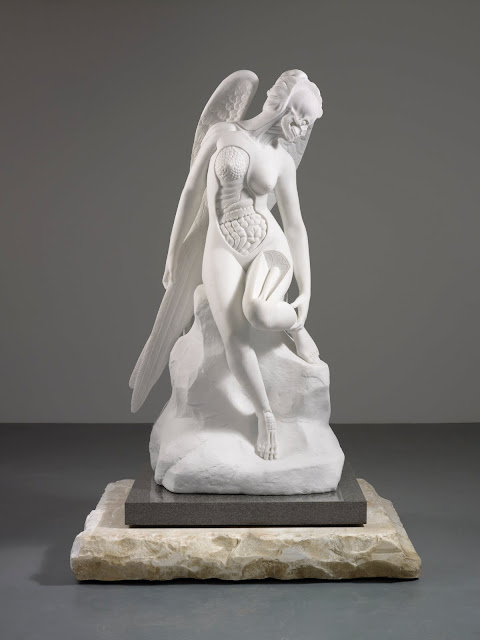
                      The Anatomy of an Angel, 2008, Carrara marble

As many know, I have a great dislike for Damien Hirst.  I find his work over rated and his personality arrogant.  I constantly ask myself  what everyone sees in his work.  I can appreciate it's aesthetic appeal, but cannot help but constantly remind myself that he did not create the pieces himself.  I also bring up the question 'is this really art?', especially to 'Away from the Flock'.  Personally, I would not consider it so, but it is all down to personal opinion, so there is no definitive answer.


Thursday, 9 June 2011

The National Galleries, Oslo, Norway

The National Museum of Art, Architecture and Design

Assume Vivid Astro Focus VIII
 
    Crushed Cigarette Packs, Ceiling Cocktail, Garden X, 2004–2009, installation

This was the first room I entered at the The National Museum of Art, Architecture and Design.  The lighting changed dramatically making it hard to view the floor the ceiling collage.  The scale of the work, being that of an entire room, was impressive, but I do not feel I could take in and appreciate it in it entirety due to the harsh lighting conditions.

Anish Kapoor

                     When I am Pregnant, 1992–1998, sculpture

My first reaction to 'When I am Pregnant' was indifference.  However, on second viewing I am amazed at the forms perfect shape.  The smooth transition from flat wall to delicate bulge makes me ask 'how is it so perfect?'

Jon Gundersen
assume vivid astro focus VIII: «Crushed Cigarette Packs, Ceiling Cocktail, Garden X», 2004–2009, installation
Louise Bourgeois: «CELL VIII», 1998. Metal, tapestry, fabric, marble and steel. 274,3 x 335,2 x 254 cm. Photo: Peter Bellamy, courtesy Cheim & Read, New York
Else Marie Hagen: «Cover», 2010, installation
William Kentridge: «History of the Main Complaint», 1996, video projection, 5:38 min
Per Maning: «To Oscar», 1996, video projection, loop
Maria Serebriakova: «Untitled»
Christian Boltanski: «Shadow Theatre», 1984, installation
Ilya Kabakov: «The Garbage Man (The Man Who Never Threw Anything Away)», 1988–1995
Bjarne Melgaard: «New love, old paint … (Dedicated to Margaux Hemingway) Make me clean again: Some pain poems, the universe according to Paul Gaugin, sex in the artworld and one week of complete misery…», 1996–1997, installation
Per Barclay: «Untitled», 1993, installation
Anish Kapoor: «When I am Pregnant», 1992–1998, sculpture

                      Vann på vei mot havet, 2007, installation

'Vann på vei mot havet' is a cleverly build water fountain installation.  The careful placement of each steel teapot, balanced down a ladder, gives a soothing trickling sound to go alongside its novel appearance.

William Kentridge

   Felix i eksil, 1994, 9:00 min

Willian Kentridge's film, created sketch by sketch caught my attention for quite some time.  The fluid change between frames left me in awe and the interesting, contemporary storyline kept me gripped.

The National Gallery of Norway

Edvard Munch

                      The Scream, 1893, oil, tempera and pastel on cardboard


In great ignorance, I did not realise that Edvard Munch was Norwegian, or that the famous 'The Scream' painting was located in Oslo.  So, to my surprise and joy, there it was, in The National Gallery of Norway.  Although smaller in real life than I had expected, it was still as impressive, if not more so, in person.


Wednesday, 1 June 2011

Designmuseum Danmark, Copenhagen, Denmark

 Lady Sings the Blues by Ane Henriksen

   A Swaddling Room, 2011, photographic print

                      Husalter, 2011
   
    Bottom Line, silk, linen, weave

    Detail


Ane Henriksen created a very intimate exhibition and used a lot of varying media to create her work.  Large scale, macro photographs of the body, observational sketches and large weavings were among the work on display.  The choice of the human body for a subject is one I have explored myself, and has been done by many others in the past.  Henriksen achieved a new angle on this subject, literally.  The personal view of the body, as seen in 'Husalter' has a slight humour to it.  Although I was a little bit repulsed by the 'A Swaddling Room' prints, I can appreciate their scale and detail, as well as the fact they conjured such a strong response, even if it was a negative one.  However, for me the most astounding pieces were the textile weavings.  The scale, density, detail and achievement of drawing all filled me with admiration.

Tuesday, 3 May 2011

The Nordic Museum, Stockholm, Sweden

Tord Boontje
                     Midsummer light, tyvek


Tord Boontje is a well-known Dutch designer who used laser cutting to create tyvek (a non woven, versatile fabric) forms, inspired by nature.  'Midsummer light' is probably one of his most recognisable pieces.  His work is also available to the masses, as he creates work for famous stores such as Habitat. 

Swedish Design

                    Himmeli


Himmeli's are a Scandinavian form of decoration, traditionally used at Christmas.  I first came across these amazing forms in Finland.  They are made of straw and string, but these one also features other various decorations, including pom poms, to make it more excessive.


Dala Horses are a traditional Swedish handicraft and popular souvenir.  This makes it popular amongst Swedish designs as a creative subject.  This fabric roll, depicting various Dala personalities is just one example of many ways in which the motif has been used. 


Geometric shapes and bright colours are another dominant feature in Swedish fabric design.  They create a striking contrast to the very plain, functional furniture design.


Tuesday, 15 March 2011

Kuopio Art Gallery, Finland

Leena Mäki-Patola


Leena's clay panels and vessels became a great inspiration for my self directed clay work.  After visiting the gallery, her pieces gave me many ideas on experimenting with glazes and slips, as well as how I could display my own work.  Her textural surfaces, created with glazes, metal and using contrasting clays as slips are all elements that make it successful and interesting.  Her careful consideration of colour, particularly the harsh difference between blue and red are eye catching and work well with the grid style display.  I also find the rawness of the materials highly attractive.

Eunice Geustyn
    Sunset Beach, New Crossroads, Crossroads, Bishop's Court, 2009, mixed media on paper

Although I did not find Eunice Geustyn's embroidered prints the most exciting part of the exhibition, I feel that I can relate to her style.  The black and white prints, both subtle and detailed, made a great base onto which simple stitch was applied.  I also enjoyed the laid back approach to the way in which it was displayed, simply by hanging it from a line.

 Kristiina Korpela

   Kukkameri (flower sea), 2008

   Saraako, 2010-2011, glass

Kristiina Korpela had the greatest presence at the Vessi, Water's exhibition.  To begin with, I found myself feeling indifferent to her flower sea collection.  However, after watching the various plastic items float around in the tank, I began to quite enjoy it.  Although very simple, the flowing movement was very mesmerizing.  Her glass vessels dominated the ext of the exhibition halls.  After working with hot glass myself, I appreciate the interesting forms she has been able to create.

Saturday, 23 October 2010

The State Hermitage Museum, St. Petersburg, Russia


The Winter Palace in St. Petersburg houses The State Hermitage Museum, one of the largest and oldest museums in the world.  Its collection, only a small part of which is on display, comprises of nearly 3 million pieces, including the largest collection of paintings in the world.  Whilst visiting, I was lucky enough to see work by Da Vinci, Matisse, Picasso, Kandinsky, Rembrandt and Michelangelo.  The guided tour provided me with an invaluable view of the museum.  Not only were the items within the museum an honour to view, but the building itself was an extravagant work of art.